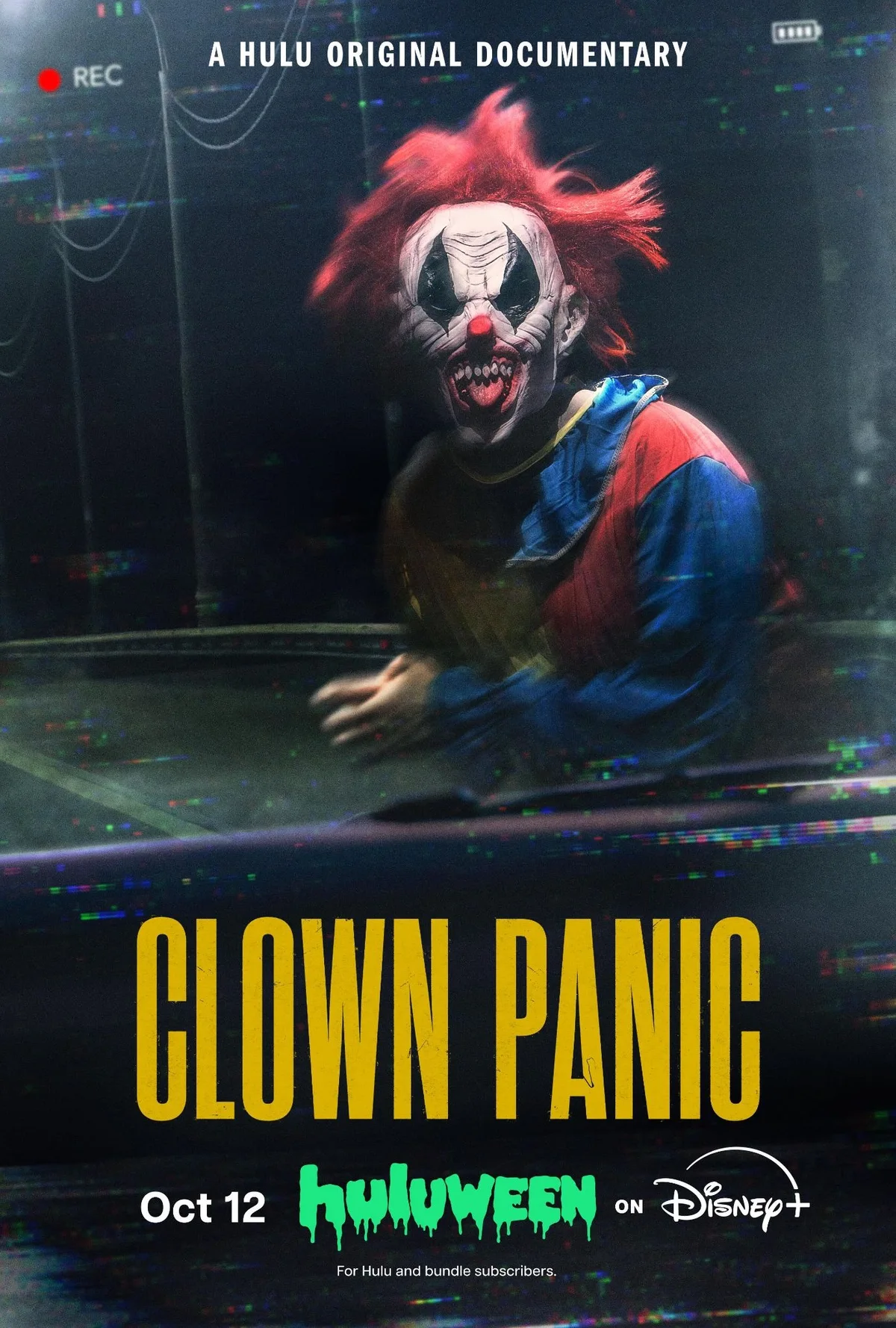
Official key art for Clown Panic. Courtesy of Hulu.
Ten years ago, reports of clowns lurking in the woods spread from a small South Carolina community to the rest of the country. Hulu’s documentary Clown Panic asks how that happened, and why the story still feels familiar.
The Last Shot Podcast spoke with the two people who brought it to the screen. Zachary Heneden sat down with director Ed Perkins, the Academy Award-nominated and BAFTA-winning filmmaker behind The Princess, Tell Me Who I Am and Black Sheep. Tyler Henderson spoke with producer Jonathan Chinn, the Emmy Award-winning co-founder of Lightbox, who made the film with his brother, Simon Chinn, and Perkins. Suzanne Lavery is executive producer.
Both men started out unconvinced, and both arrived at the same conclusion: the film is not really about clowns.
A story that refused to stay small
Chinn first met the story at home. “I do remember it happening because I had a young child at the time,” he said. His son became afraid of clowns, and “a lot of it was because, you know, it was all over social media.”
About three years ago, Chinn returned to it. “I started to dig into it a little bit and try and put the pieces together as to what it was and what happened and why clowns and why then,” he said. “I realized there was actually a bigger story to tell about where we were in America at that time, and that this was actually a moral panic.”
Perkins had dismissed it too. He had moved back to the UK about 15 years ago and remembered the sightings only vaguely, as “one of those kind of small, fleeting, flash-in-the-pan stories that kind of blew up on social media and then disappeared pretty quickly.”
“How wrong I was,” he said. “When you strip away all the kind of weird layers of clown absurdity and everything else that was happening back then, what you find in this story is something very, very profound and deeply human. The story is about many things, but at the heart of it, it’s about fear.”
Selling it was harder. “This was not the easiest project to develop, and it wasn’t the easiest project to sell, if I’m being honest,” Chinn said. “A couple of the distributors sort of looked at me like I was crazy, like, who wants to watch a film about clowns?” Hulu, he said, “got it immediately” when he raised it over a lunch meeting that “wasn’t even an official pitch.” Perkins needed convincing as well. “He’s like, ‘Really, clowns?’” Chinn said. “I was like, ‘Yes, really clowns,’ because if we get it right, people will come to it.”
Horror tropes, real fear
The film is billed as darkly funny, unsettling and unexpectedly emotional. Perkins pointed to Scream as a model for walking “this tightrope between horror and comedy so well and so knowingly.” He wanted audiences to retrace the path many people followed in 2016: curiosity first, then caution, then real alarm.
“Within weeks, there were hundreds and hundreds of clown sightings happening all over America,” he said. “Entire school districts were closed down. … This got very, very serious, and very quickly.”
The interviews shaped the look of the film. Many of the people who had seen clowns, Perkins said, told stories that “sounded straight out of a horror movie.” He stressed that he did not doubt their sincerity. Instead, the team decided to be on their side, “to take what they’re saying seriously, and also to bring it to life in a way that really embraced the horror world, the horror tropes.” He added, “I want people to feel this as much as think about it.” He also admitted to watching Killer Klowns from Outer Space “more than a few times,” and said the film leaves Easter eggs for horror fans, “some subtle, some not so subtle.”
The Salem witch trials of the digital age
Both filmmakers placed the clowns in a long line of moral panics. Chinn listed the Salem witch trials, the Red Scare and the Satanic Panic, moments when “minorities and outsiders somehow become the receptacle of our own anxieties.”
What changed in 2016 was the speed. “I think social media supercharged this panic,” Perkins said. “When we were making this film, we often referred to it as a kind of Salem witch trials of the digital age. Maybe this was the first moral panic that really spread virally on the internet.” Underneath it, he said, was real anxiety: “There was a lot going on in 2016 culturally, politically, economically. Whatever your beliefs, whatever your views, people were genuinely afraid.”
Chinn described the year as the moment “the internet went from a fun place to a very dark place.” He also noted that the people who could feel this most were Hulu’s own viewers, a younger audience “who would have lived through it.”
Perkins said the film takes no political side. “I was certainly not out to make any kind of partisan points,” he said. “We go in with a point of view, but not with an agenda at all. I wanted people to watch this film as a cautionary tale for what happens when fear takes over. The consequences don’t stay on social media. The consequences happen in the real world.”
The cost behind the punchline
Both men stressed that the story ends in tragedy. Perkins said the panic ultimately cost a young person’s life, an outcome the film addresses at its close. Chinn put it plainly: “You can laugh at it, and it is funny, but at the same time it’s important for us as a society to look at ourselves and check ourselves.”
The fallout reached working clowns too. One of the film’s central figures is Gilly the Clown, a professional entertainer whom Perkins called “an amazing human being” and one of the film’s emotional anchors. As the sightings peaked, Perkins said, clowns “became enemy number one.” Many lost work. Both filmmakers pointed to a pop-culture casualty as well. In Chinn’s words, “Ronald McDonald was fired.”
By the end of the film, Perkins said, “the clowns sort of disappear from the story,” and Gilly, still in full makeup, becomes simply a person “trying to understand what’s happening to him and to other people around him.”
Entertainment plus
Chinn began in formatted reality, including as a camera operator on Survivor. He said his work has always been about “letting people bear witness to their own narratives.” His standard for a documentary is “entertainment plus”: the audience should enjoy it, “but come away saying, like, you know what, I look at this story, these people, my life, the world I live in a little differently.”
His advice to emerging filmmakers was to “find the surprising stories, find the stories that aren’t obvious,” and to give something back. “I don’t really want to be in that business of just solely exploiting other people’s misery,” he said. “You got to give something back to the subject. You got to give something back to the viewer.”
Asked what viewers should take away, he came back to the platforms where the panic began. “It’s also a story about social media,” he said. “We’re all part of it. We’re all feeding into it. The question is what comes out the other end. And I think Clown Panic is an example of what can come out the other end. And, you know, beware.”
Perkins put it more simply. “Deep down, this film is not about clowns,” he said. “It’s about all of us. It’s about the way that we deal with stories, the way that we try to identify fact from fiction, and the way that fear makes us capable of doing things that perhaps we didn’t think we were capable of doing.”
Clown Panic is streaming now on Hulu and on Hulu on Disney+ for bundle subscribers in the U.S., and on Disney+ internationally. Directed by Ed Perkins. Produced by Jonathan Chinn and Simon Chinn for Lightbox. Executive produced by Suzanne Lavery.
Quotes are drawn from The Last Shot Podcast interviews with Ed Perkins (hosted by Zachary Heneden) and Jonathan Chinn (hosted by Tyler Henderson), lightly edited for clarity. Key art courtesy of Hulu. Watch the official trailer.