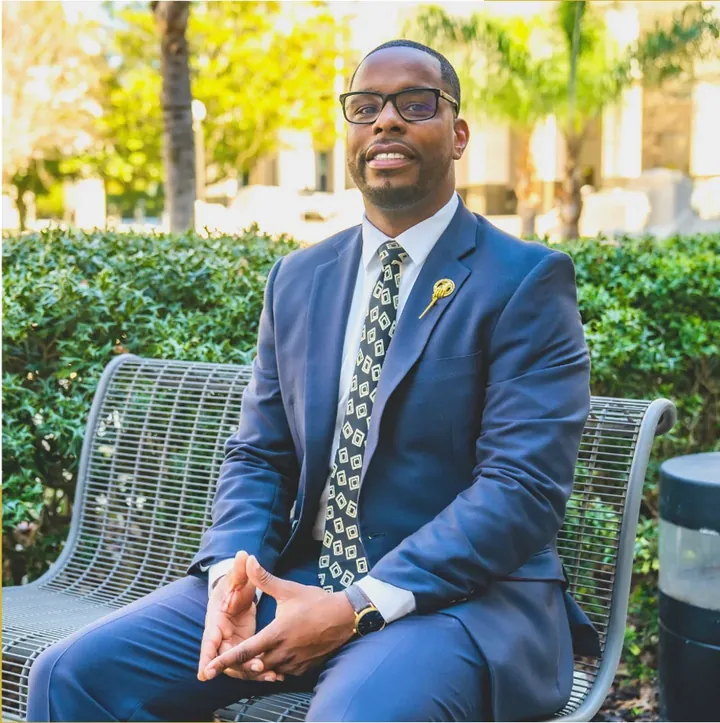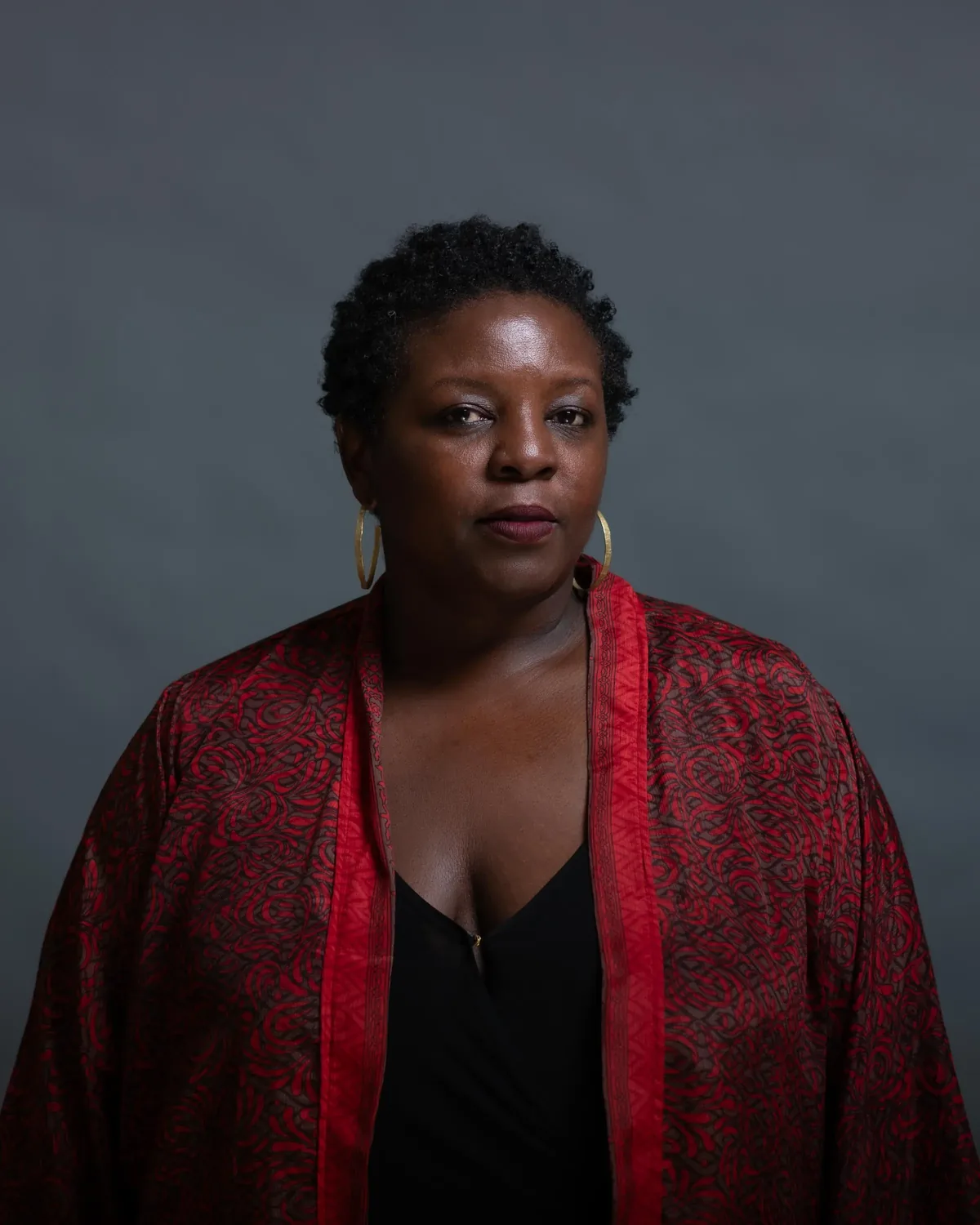
Yoruba Richen. Official headshot.
Content note: This article discusses sexual violence and incarceration.
When Yoruba Richen joined Zachary Heneden and I on The Last Shot Podcast, one question kept surfacing beneath our conversation: How do you return a woman’s story to public attention while respecting her right to decide how much of herself she shares?
That question sits at the center of Free Joan Little, Richen’s short documentary about a young Black woman whose fight for her life brought civil rights, feminist, and prison reform activists into a shared struggle. Drawing on archival footage, contemporary interviews, animation, and trial testimony, the film revisits a case that challenged whose account of violence the public was willing to believe.
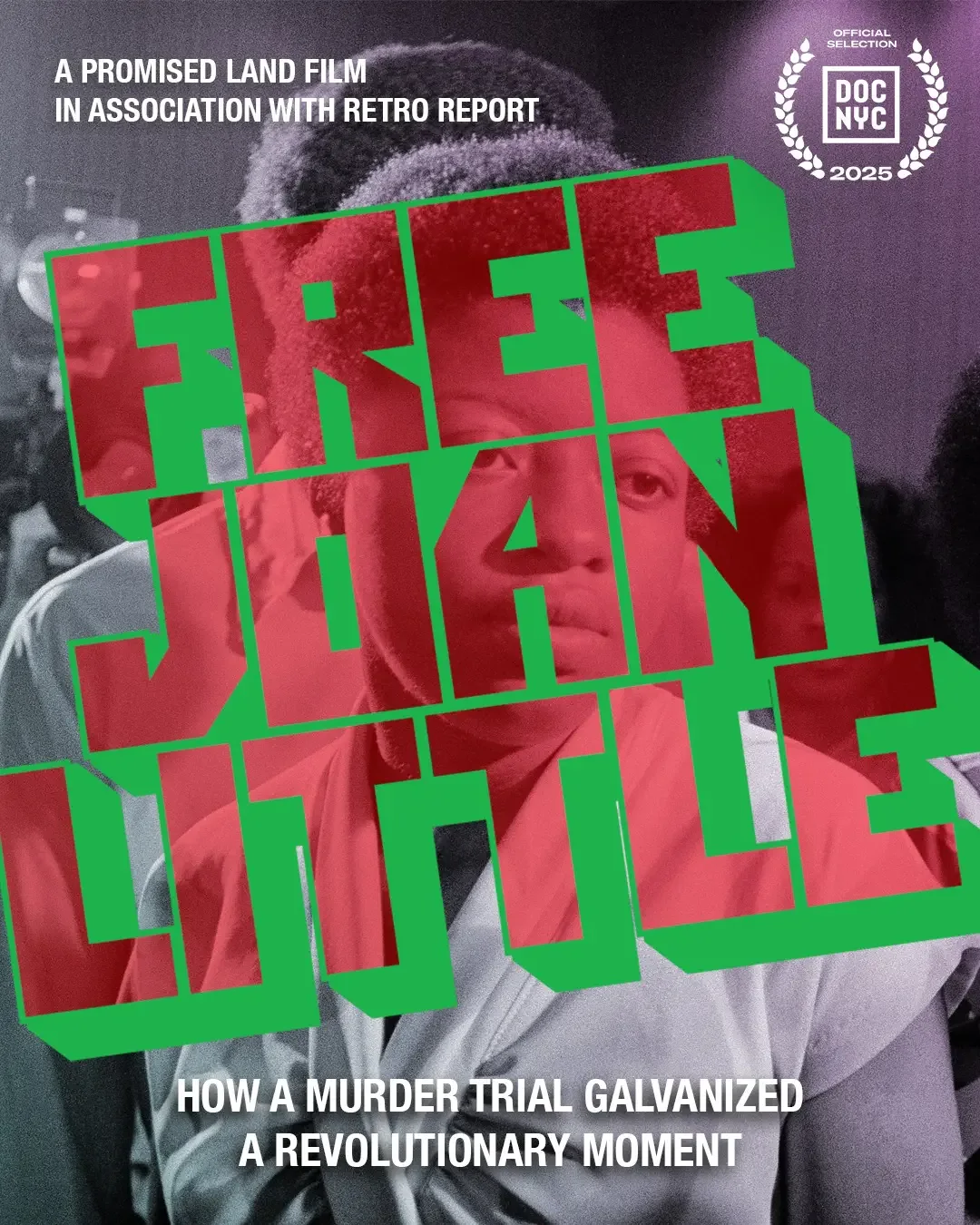
The poster for Free Joan Little.
In 1974, 20-year-old Joan Little, whose first name is pronounced “Jo-Ann,” killed a white jailer in North Carolina who she said attempted to rape her. Her 1975 acquittal became a landmark in American legal history: she is widely credited as the first woman in the United States acquitted of murder after using deadly force to resist sexual assault. Angela Davis and Rosa Parks were among the activists who rallied to her cause.
Richen’s interest extends beyond the verdict to the conditions that made Little’s defense so difficult, and the organizing that helped make an acquittal possible.
Working with an archive that worked against her
Some historical records preserve the prejudice of the people who created them. Richen faced that problem directly in the headlines and broadcasts surrounding Little’s case.
In our conversation, she explained that including hostile coverage was necessary to convey the forces Little confronted. A young Black woman in jail was making an allegation against a white jailer, in an environment where women reporting sexual assault already faced disbelief and attacks on their character.
The editorial challenge was to show that hostility within its context. The material helps explain what Little was up against and why a campaign beyond the courtroom mattered.
The courtroom itself presented another problem: cameras had not recorded the trial. Richen had trial transcripts and court drawings, but licensing the drawings from television networks was expensive. She turned to animation and actors reading selected testimony, including Academy Award nominee Danielle Brooks as Little’s voice.
Richen told us she had envisioned Brooks reading Little’s words and was thrilled when the actress agreed. The approach brings the testimony into the film through Little’s recorded language, giving audiences a way to encounter her account of what happened.
Respecting the person behind the public case
Little chose not to participate in the documentary. Richen said the team reached out over roughly three years, including through people who appear in the film, and that Little remained aware of its progress.
Richen understood that revisiting the case could mean revisiting the worst experience of someone’s life. Her guiding principle, she explained, was to tell the story as much as possible from Little’s perspective and preserve the dignity the state had threatened to deny her.
That distinction matters. A person can have a place in public history while retaining the right to privacy. The film’s existence does not require Little to perform her trauma again for an audience.
Richen also described the project as a focused short rather than a full biography. Its boundaries required leaving out portions of the trial and some of the wider political context of the period. Those choices keep attention on the case and the movement around it, while leaving room for viewers to continue learning afterward.
How a story becomes a movement
When I asked what Little’s defense campaign could teach independent media and storytellers today, Richen returned to the relationship between narrative and collective action.
The campaign brought together groups that did not agree on every issue. Little’s case gave them a shared demand for justice. For Richen, that history offers both inspiration and practical lessons about coalition building.
Music helped carry the campaign. She described Bernice Johnson Reagon’s song associated with Sweet Honey in the Rock as an organizing tool, and an essential element of the film. The score also had to carry the energy of people mobilizing and the suspense of a trial whose outcome they could not know.
The conversation stayed with me because it spoke directly to the work of independent media. Telling a story requires decisions about whose words lead, what context audiences receive, and how people encounter one another through the work. Those decisions can shape what becomes possible beyond a screening.
Richen has seen those connections firsthand. At a screening near Raleigh, three women introduced themselves as the daughters of a juror who had voted for acquittal. She recalled the encounter as one of the project’s most meaningful surprises. The history in the film still lives in families and communities that can walk into the room.
A filmmaker connecting history to the present
Richen brings a substantial body of documentary work to this project. She co-directed the Peabody Award-winning The Rebellious Life of Mrs. Rosa Parks, and her films include The Green Book: Guide to Freedom, How It Feels to Be Free, and the NAACP Image Award-winning The Killing of Breonna Taylor. She is also the founding director of the Documentary Program at CUNY’s Craig Newmark Graduate School of Journalism. She is also the founder of Promise Land Film.
Her advice to emerging filmmakers was to make historical work feel alive to contemporary audiences. Research needs a form that helps people engage with the past and recognize its relevance.
Free Joan Little is directed and produced by Richen, produced by Christalyn Hampton and Bonnie Bertram, and edited by Hannah Vanderlan. Retro Report presents it as a Promised Land Film in association with Retro Report. Field of Vision lists the project among those supported through the Original Voices Shorts Pitch 2023.
Recognition and a growing audience
The documentary’s festival run has brought significant recognition. Its wins include Best Documentary at LA Shorts International Film Festival, which also lists an Immaculate Heart Community Social Impact Award for the film; the REEL SOUTH Award at RiverRun; Best Documentary Short at the Morehouse College Human Rights Film Festival; and the short-documentary jury prize at Hot Springs Documentary Film Festival.
It was also named to the International Documentary Association’s 2026 Best Short Documentary shortlist and the Shorts List for the 2027 Cinema Eye Honors. These are separate awards processes, with shortlist recognition distinct from a final nomination or win.
The supplied festival materials trace a wide circuit: DOC NYC in 2025; and 2026 engagements or selections at Provincetown, Roxbury, Ann Arbor Black Film Festival, NC Black Film Festival, Charlotte Black Film Festival, Indy Shorts, BlackStar, BronzeLens, Greater Cleveland Urban Film Festival, Sidewalk, New/Next, Mill Valley, Woodstock, Rocky Mountain Women’s Film Festival, and Montclair. They also document an honorable mention at San Antonio Black International Film Festival and nominations at Woodstock, Detroit Black Film Festival, Women Of The Lens, and Three Rivers Film Festival.
Beyond that circuit, the film was programmed for BADWest’s Day of Black Docs, an annual event devoted to documentaries centering Black experiences. As of November 5, the supplied screening announcements also list forthcoming appearances at Centre Film Festival on November 6 and Teaneck and Double Exposure on November 7.
Richen told us a PBS airing is planned for spring 2027. The prospect of a wider audience brings the film’s central invitation into focus: learn more about Little’s case and consider how struggles over incarceration and justice take shape in your own community.
When I asked what she most wanted viewers to carry away, Richen answered directly: “Inspiration to continue the struggle. Inspiration to resist.”
For a film grounded in the work of people who organized around a young woman’s right to defend herself, that invitation gives the history somewhere to go.
Hear our conversation with Yoruba Richen on The Last Shot Podcast, an LSMG show in collaboration with LEDGERA Magazine. Find film information and screening updates at Retro Report. Follow the film on Instagram at @freejoanlittle and Richen at @redrubes14.
Listen and learn more: Explore the film and screening updates · More about the project · Promised Land Film · Spotify · Apple Podcasts · YouTube · Chicken & Egg Films independently lists a 2027 PBS premiere